
Your Decision-Making Process Was Designed for a Different World
Most organisations still make decisions using structures designed for a slower, information-scarce era.
Information travels up a chain. Approval travels back down. By the time something is actioned, the conditions that prompted it have already shifted.
This was once acceptable. It is now a competitive weakness.
AI changes not just the speed of decision-making, but the nature of it. Organisations that fail to adapt how decisions are made will consistently fall behind those that do.
The Real Cost of How You Decide Today
Traditional decision-making models suffer from structural limitations that become more severe as business accelerates.
| Information bottlenecks | Human decision-makers cannot process all relevant data fast enough. Decisions are delayed or made on incomplete information. |
| Cognitive bias | Biases such as anchoring and confirmation bias distort judgement, particularly under pressure. |
| Hierarchical delay | Multiple approval layers create queues. Decisions are often made by those furthest from the problem. |
| Inconsistency | Similar situations produce different outcomes depending on who decides, eroding trust internally and externally. |
| Limited scalability | Decision quality declines as volume increases. Human-led systems struggle to keep pace with simultaneous demands. |
These issues have always existed. AI simply exposes and amplifies the gap between organisations that address them and those that do not.
Most organisations don’t have a technology problem. They have a decision-making problem that AI simply exposes.
AI-augmented decision-making is not about replacing humans. It is about redesigning how decisions are made.
AI handles:
- Data processing at scale
- Pattern recognition
- Routine and repeatable decisions
Humans focus on:
- Strategic judgement
- Ethical considerations
- Contextual reasoning
The value comes from combining both.
Real-World Examples: How Decision-Making is Changing
- Zara uses AI to detect emerging trends in real time, compressing design and supply chain cycles from months to days
- JPMorgan Chase applies machine learning to analyse legal contracts in seconds, replacing hundreds of thousands of manual hours
- Stitch Fix blends algorithmic recommendations with human stylists to balance scale with trust
The pattern is consistent. AI does not remove humans. It reshapes their role.
These examples point to a deeper shift. Decision-making is no longer constrained by hierarchy but enabled by access to real-time data and intelligent systems.
This requires a fundamentally different decision architecture
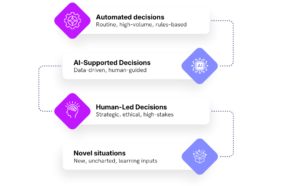
Decision Architecture in the AI Age
From Reactive to Predictive Decision-Making
The most important shift is not speed. It is anticipation.
AI enables organisations to move from reacting to events to predicting them.
Examples include:
- Demand forecasting
- Predictive maintenance
- Fraud detection
- Customer behaviour modelling
These capabilities allow organisations to act before issues or opportunities fully materialise.
However, predictive decision-making depends on data quality.
- Poor data leads to poor predictions
- Outdated data leads to irrelevant decisions
This makes data governance a continuous discipline, not a one-off initiative.
Designing a Decision Architecture
Not all decisions should be treated the same. Effective organisations design decision systems based on type, complexity, and impact.
Decision Types
| Decision Type | Description | Approach | Examples |
|---|---|---|---|
| Routine decisions | High volume, repeatable, rules-based | Automated fully | Pricing adjustments, inventory management |
| Complex decisions | Multiple variables, trade-offs required | AI-supported, human-led | Scenario modelling, operational trade-offs |
| High-stakes decisions | Significant risk, regulatory or ethical impact | Human-led with AI input | Strategy decisions, regulatory judgement |
| Novel situations | No precedent, ambiguous context | Human-led entirely | Crisis response, new market entry |
Speed must also be designed intentionally.
Some decisions require real-time execution. Others benefit from structured deliberation. Both must coexist.
Executive Takeaway: Redesign How Decisions Get Made
The question is not whether AI should be used in decision-making.
It is whether your current decision processes are still fit for purpose.
Three actions to take now:
- Map decision bottlenecks
Identify where delays, distortions, and inconsistencies occur - Classify decision types
Define where automation adds value and where human oversight is essential - Establish governance early
Build accountability, auditability, and override mechanisms before scaling
Organisations that redesign decision-making for the AI age will not just move faster.
They will operate with greater consistency, clarity, and scale.
Those that do not will continue operating on structures designed for a world that no longer exists.
Need support redesigning decision processes for AI?
ITAA.ai helps organisations rethink decision architecture, governance, and operating models to unlock measurable value from AI.
Speak to our team or explore our AI Strategy services.